Featured Blog
When Common Doesn’t Mean Highest Risk:

Every veterinary hospital team hear same client concerns constantly: vomiting, lethargy, appetite changes, pain, toxicity, skin concerns, breathing issues, mobility changes, bleeding, and diarrhea. These complaints become so familiar that it's easy to assume they're also the concerns most likely to require emergency care.
But our data tells a different story.
GuardianVets analyzed 610,975 documented triage outcomes across 43 normalized chief complaint groups to better understand the relationship between client demand and clinical urgency. What we found highlights an important distinction:
The complaints practices hear most often aren't always the complaints most likely to require emergency care.
For veterinary hospitals, that insight matters. It can influence training priorities, protocol development, staffing decisions, and ultimately the care experience delivered to pet owners.
Key Findings
GuardianVets analyzed 610,975 documented triage outcomes
The top 10 chief complaint groups represented approximately 57% of all documented cases
The most common complaints were not always the most likely to require emergency care
Cases involving multiple complaint groups became progressively more likely to require emergency care direction
Effective triage depends on understanding both complaint frequency and complaint severity
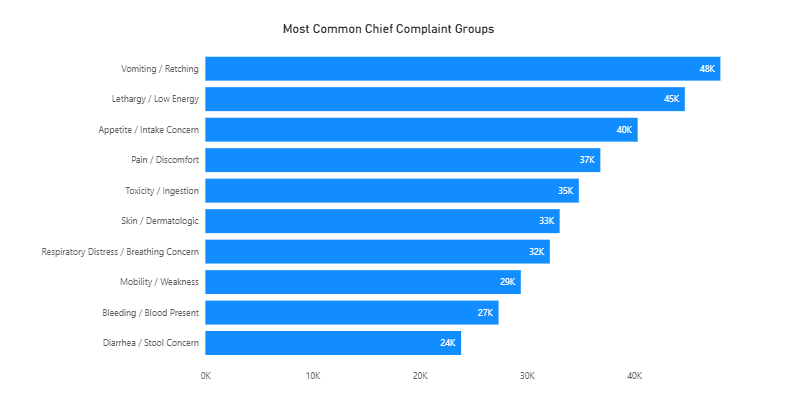
The most common chief complaint groups represented a large share of documented demand. The top 10 complaint groups accounted for approximately 350,485 cases, or about 57% of all article outcome cases reviewed.
The highest-volume complaint groups were:
Vomiting / Retching: 48,030 cases
Lethargy / Low Energy: 44,716 cases
Appetite / Intake Concern: 40,310 cases
Pain / Discomfort: 36,834 cases
Toxicity / Ingestion: 34,831 cases
Skin / Dermatologic: 33,041 cases
Respiratory Distress / Breathing Concern: 32,117 cases
Mobility / Weakness: 29,417 cases
Bleeding / Blood Present: 27,338 cases
Diarrhea / Stool Concern: 23,851 cases
These complaint groups represent the issues veterinary teams are most likely to encounter repeatedly. They are important because they drive workload, client communication needs, protocol use, documentation, and follow-up volume.
But high volume alone does not fully describe clinical urgency.
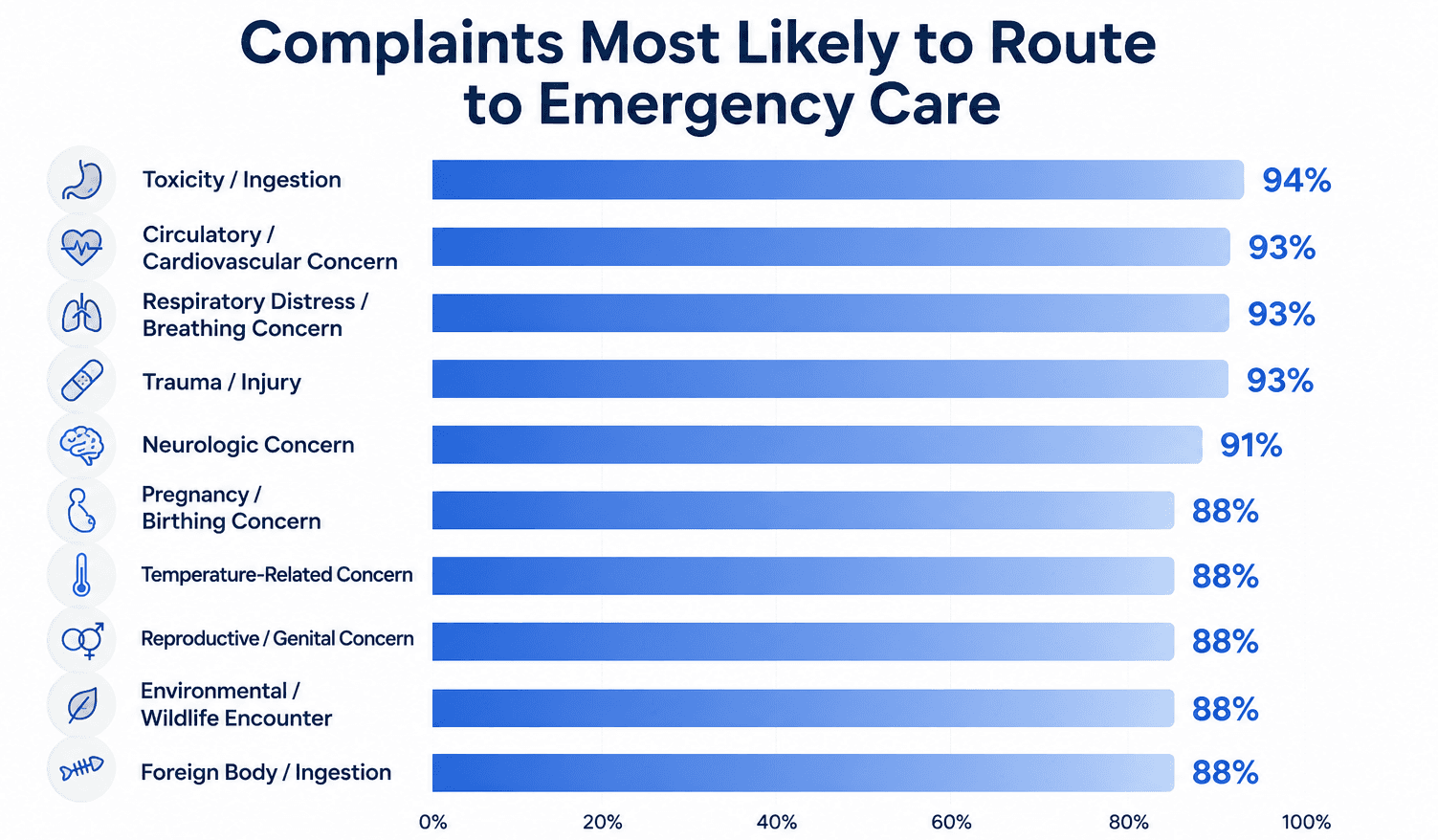
When complaint groups were ranked by Emergency Care Share, a different pattern emerged. Some of the highest emergency-care rates were associated with complaint groups that were not always the highest-volume categories.
The complaint groups with the highest emergency care share included:
Toxicity / Ingestion: 94%
Circulatory / Cardiovascular Concern: 93%
Respiratory Distress / Breathing Concern: 93%
Trauma / Injury: 93%
Neurologic Concern: 91%
Pregnancy / Birthing Concern: 88%
Temperature-Related Concern: 88%
Reproductive / Genital Concern: 88%
Environmental / Wildlife Encounter: 88%
Foreign Body / Ingestion: 88%
This comparison is where the myth starts to break down. Some high-volume categories, such as vomiting, lethargy, appetite changes, and pain, create substantial demand. But the highest emergency-care shares are often tied to concerns where the presenting complaint signals a greater likelihood of immediate risk, escalation, or urgent direction.
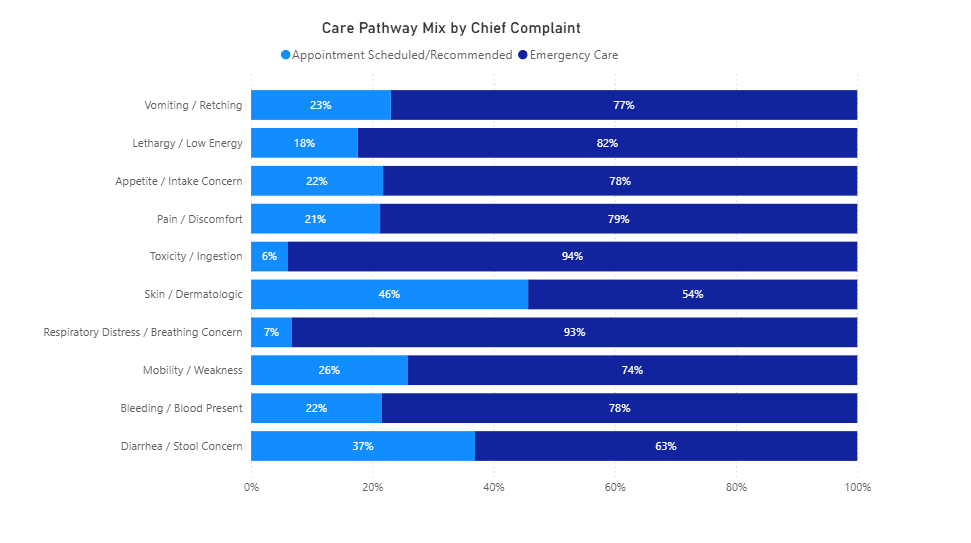
The care pathway mix also shows why chief complaints cannot be treated as one-dimensional. Many complaint groups routed heavily toward emergency care, but the degree varied by category.
For example, some complaint groups had especially high emergency care shares, including toxicity, respiratory distress, trauma, neurologic concern, bite wounds, foreign body ingestion, and seizure-related concerns. Other complaint groups had a larger appointment-related share, such as ear concern, medication/DVM question, skin/dermatologic concerns, coughing/upper respiratory concerns, and behavioral concerns.
This matters because the same broad category of client demand can represent different levels of risk depending on the pet’s symptoms, duration, severity, history, and context. A complaint label alone does not determine the right next step. The value of triage is in helping separate concern from urgency and routing each case appropriately.
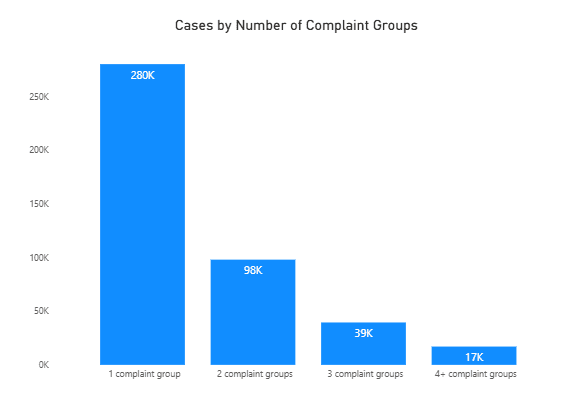
The data also suggests that complaint complexity matters. Most cases involved a single complaint group, but a meaningful portion included multiple complaint groups.
Of the 434,529 cases included in the complaint count bucket analysis:
279,946 cases, or about 64%, involved 1 complaint group
98,001 cases, or about 23%, involved 2 complaint groups
39,495 cases, or about 9%, involved 3 complaint groups
17,087 cases, or about 4%, involved 4 or more complaint groups
This helps show that many pet owner concerns are not isolated. Clients may call with overlapping symptoms, such as vomiting plus lethargy, appetite changes plus pain, or mobility issues plus weakness.
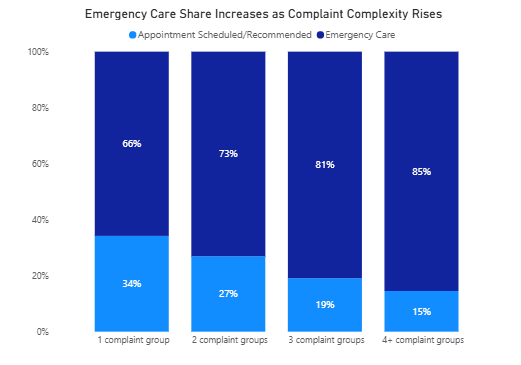
As the number of complaint groups increased, the share of cases routed to emergency care also increased.
1 complaint group: 65.8% Emergency Care
2 complaint groups: 73.1% Emergency Care
3 complaint groups: 80.9% Emergency Care
4+ complaint groups: 85.5% Emergency Care
This pattern suggests that cases with multiple documented concerns may require especially careful triage. The presence of multiple symptoms does not automatically mean an emergency, but it may increase the likelihood that a case needs faster escalation, more detailed questioning, or more urgent direction.
Overall, the data does not suggest that high-volume complaints are unimportant or that lower-volume complaints are always more serious. Instead, it shows that veterinary client demand has at least two dimensions: how often a concern appears and how likely that concern is to require emergency care direction.
For veterinary hospitals, this distinction matters. High-volume complaints create recurring workload and training needs. High-risk complaints require fast recognition and appropriate escalation. Multi-complaint cases may require additional clinical judgment because combinations of symptoms can change the risk profile.
The takeaway is clear: effective triage is not just about answering the call. It is about identifying the right care pathway from the information the client provides. GuardianVets case data shows that chief complaint patterns can help hospitals better understand client demand, prioritize training, strengthen protocols, and support more consistent care navigation.
Methodology Notes
This analysis reviewed 610,975 documented article outcome cases across 43 normalized chief complaint groups. Chief complaints were grouped using normalized complaint categories. Care outcomes were grouped into broad article care outcomes, including Appointment Scheduled/Recommended and Emergency Care. Cases with multiple chief complaint groups were included in complaint count bucket analysis to evaluate how complaint complexity related to care pathway distribution.
Latest/Featured Blogs & News

Featured Blog
September 16, 2026
Every Appointment Inquiry Is Revenue Waiting to Be Scheduled
Why Appointment Capture may be the most important KPI your veterinary practice isn’t measuring. We analyzed nearly 14,000 appointment-related client interactions to see what happens after the phone rings.

Featured Blog
June 9, 2026
How to Grow Your Veterinary Practice Without Adding Staff
Growth usually gets framed as a hiring problem. Demand climbs, the schedule tightens, and the reflex is to post another front desk role. But in a tight labor market, recruiting is slow, training takes months, and the person you hire might be gone by spring.
Featured Blog
August 12, 2026
When Common Doesn’t Mean Highest Risk: