Featured Blog
What Actually Happens on One After-Hours Call, Start to Finish
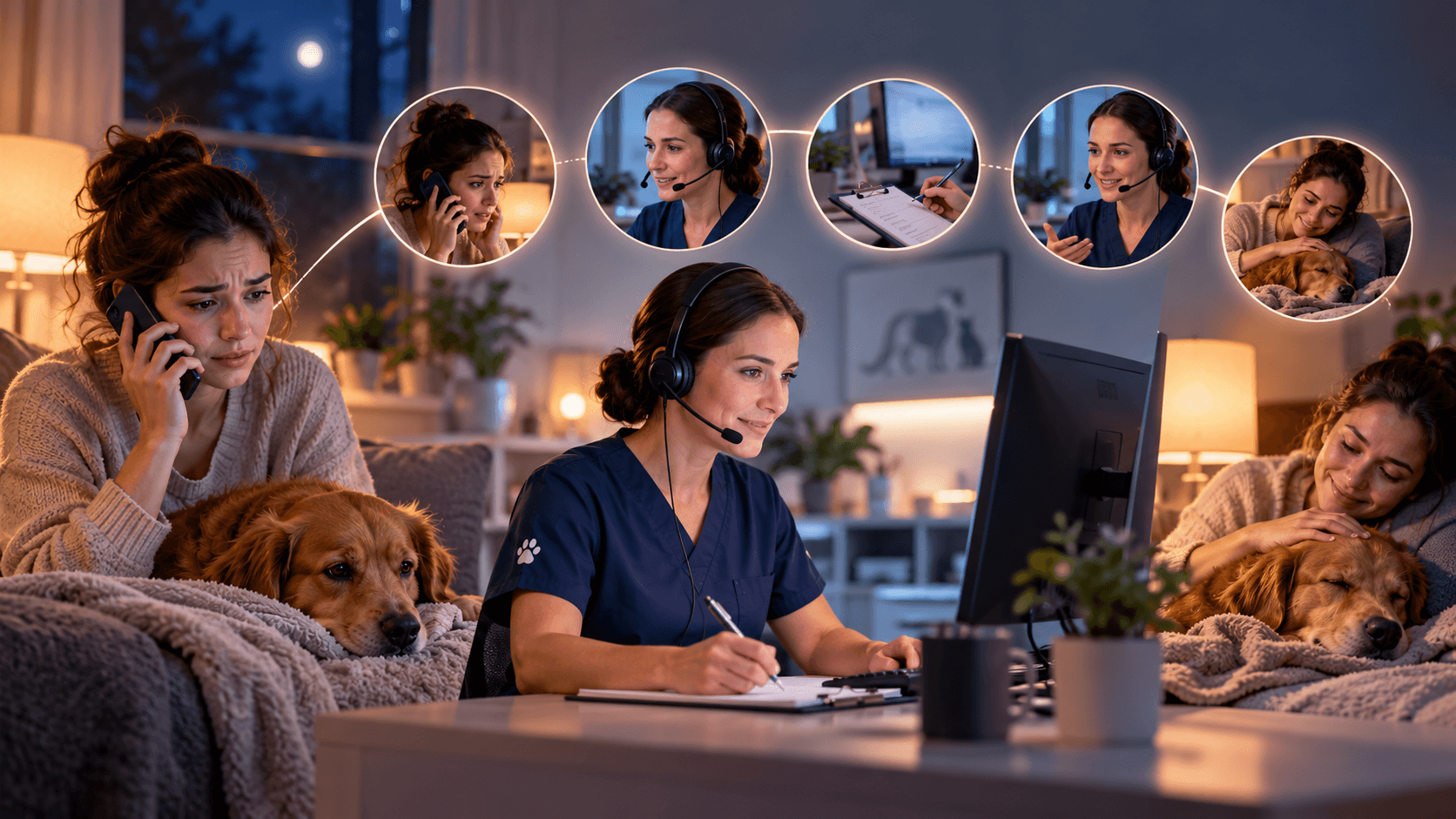
A client we will call Dana is on the couch with Baxter, a six-year-old Labrador who has vomited twice in the last hour and seems a little restless. Your clinic closed at six.
We talk a lot about why after-hours coverage matters. We talk less about what it looks like, minute to minute, when the phone rings at 11 p.m., and your practice is dark. So this time, instead of making the case, we want to show you the mechanics: one call, start to finish, the way it moves through our veterinary call coverage from the first ring to the moment your team reads about it the next morning.
The scenario is ordinary on purpose: no dramatic trauma, no clear-cut emergency, just the kind of call that fills the after-hours hours at every practice and quietly decides whether a client stays yours.
9:47 p.m. The Call Comes In
A client we will call Dana is on the couch with Baxter, a six-year-old Labrador who has vomited twice in the last hour and seems a little restless. Your clinic closed at six. Dana is worried enough not to wait until morning, but unsure this is worth a drive to the ER. She calls the only number she has, your practice line.
Because you route your after-hours calls to us, it does not hit a voicemail greeting. It rings through to a live, U.S.-based Credentialed Veterinary Technician who answers in your practice's name. To Dana, she has reached your clinic. That matters more than it sounds, because the alternative is a pet owner already typing symptoms into a search bar.
The First Two Minutes: Listening and History
The technician answering is not reading from a generic script. Every GuardianVets CVT has a minimum of three to five years of hands-on clinical experience, so she has heard a restless, vomiting dog described a hundred times and knows what to ask next.
She takes a history the way your own team would. How many times has Baxter vomited, and what did it look like? Is his belly distended or tense? Is he still drinking? Any chance he got into something? Is he a deep-chested breed, and is the retching productive or not? Those questions are not idle. They can be the difference between a dog that needs to be seen within the hour and one that can safely wait for a morning appointment.
Working From Your Protocols, Not Ours
Here is what separates a triage service from an answering service: the technician is not applying her own judgment in a vacuum. She is working from your practice's protocols, the escalation rules and preferences we map with you before we ever take a call on your behalf.
That means the decisions she makes on this call reflect how you would want them made:
When a case should be escalated to your on-call veterinarian, and when it should not
Which presentations you always want sent to the nearest emergency hospital
How you like appointments booked, and which slots you hold open for next-day urgent cases
What you want communicated to the client, and in what tone
An after hours veterinary triage service is only as good as how well it represents the practice behind it. Following your rules, not a one-size-fits-all playbook, is what makes the call feel like it came from your team.
The Decision: Triage, Not Diagnosis
Based on the history, Baxter's signs may warrant attention but not a panicked midnight drive. The technician does not diagnose him. That is an important line, and we hold it carefully. Our CVTs assess urgency and guide the client to the right level of care. They do not diagnose, prescribe, or establish a veterinarian-client-patient relationship. Those decisions belong to you.
What she can do is tell Dana, with clinical confidence, that Baxter's presentation does not appear immediately life-threatening, what warning signs would change that, and that the right next step is a first-thing appointment with his own veterinarian. Had the history suggested a deep-chested dog with unproductive retching and a distending abdomen, the call would have gone a very different direction, escalated immediately as a possible emergency. Same number, same calm voice, entirely different outcome, because the person on the line knew which signs mattered.

Booking the Appointment
This is where coverage turns into revenue you may otherwise have lost. Rather than telling Dana to call back when the office opens, the technician books Baxter directly into your schedule, into a slot you designated for exactly this. Dana hangs up with a plan, an appointment, and the sense that her clinic was there when she needed it.
The alternative, the one that plays out nightly at practices relying on voicemail, is that Dana calls the emergency hospital instead, pays several times the cost for a non-emergency, and starts to wonder whether she needs a change of clinic.
The Next Morning: A Clean Handoff
At 7:55 a.m., your team does not walk into a full voicemail box and a guessing game. Every overnight call is documented and, through our integration with your practice information management system, tied back to the patient record. The note on Baxter is already there: time of call, history taken, guidance given, appointment booked.
Your receptionist is not reconstructing the night from memory. Your veterinarian sees Baxter at nine with the full context of what happened the night before. Continuity of care is not a slogan here; it is the practical result of noting everything and putting it where your team already works.

One Call, Multiplied
Baxter's call was ordinary, and that is the point. Multiply it across every night, weekend, and holiday you are closed, and you see what after-hours coverage protects: the client relationship, the appointment, the medical record, and your team's ability to rest without the phone.
At GuardianVets, this is what we do, one call at a time, for thousands of veterinary practices. If you would like to see how it would work with your protocols and your schedule, book a demo, and we will walk you through the whole path, from the first ring to the morning handoff.
Latest/Featured Blogs & News
Featured Blog
June 9, 2026
What Actually Happens on One After-Hours Call, Start to Finish
A client we will call Dana is on the couch with Baxter, a six-year-old Labrador who has vomited twice in the last hour and seems a little restless. Your clinic closed at six.

Featured Blog
September 16, 2026
Every Appointment Inquiry Is Revenue Waiting to Be Scheduled
Why Appointment Capture may be the most important KPI your veterinary practice isn’t measuring. We analyzed nearly 14,000 appointment-related client interactions to see what happens after the phone rings.

Featured Blog
June 9, 2026
How to Grow Your Veterinary Practice Without Adding Staff
Growth usually gets framed as a hiring problem. Demand climbs, the schedule tightens, and the reflex is to post another front desk role. But in a tight labor market, recruiting is slow, training takes months, and the person you hire might be gone by spring.