Featured Blog
Every Appointment Inquiry Is Revenue Waiting to Be Scheduled

Why Appointment Capture may be the most important KPI your veterinary practice isn’t measuring. We analyzed nearly 14,000 appointment-related client interactions to see what happens after the phone rings.
Every veterinary practice invests significant time and money generating demand. Think of the different ways time and money are spent trying to get clients to come in. There are marketing campaigns and community outreach, the practice website, social media and online reviews, as well as client referrals.
The goal is always the same: encourage pet parents to contact the practice.
But once that phone rings, an entirely different process begins. The client has already decided to reach out. They are no longer a marketing lead. They are an active opportunity. They need guidance, want to schedule care, or are looking for the next step for their pet.
At that moment, the question is no longer, “Did our marketing work?” The question becomes:
Did we capture the demand?
That is why veterinary practices should begin measuring what is called Appointment Capture Rate. It shifts the conversation away from simply answering the phone and toward something far more important: converting client intent into scheduled care.
Demand Already Exists
Appointment-related calls represent some of the highest-value interactions a veterinary hospital receives. These are not casual inquiries. Pet parents are calling because they want to:
Schedule preventive care
Address a medical concern
Follow up on a previous visit
Determine whether their pet should be seen
Find the earliest available appointment
Every one of these interactions represents demand that already exists.
The challenge is ensuring that demand doesn’t disappear before it reaches the calendar.
Measuring Appointment Capture
GuardianVets recently analyzed nearly 14,000 appointment-related client interactions from active hospitals where direct scheduling is enabled. Rather than asking whether calls were answered, we evaluated what happened after the conversation. Three possible outcomes emerged.
1. Captured demand: directly scheduled
The appointment was directly scheduled. This represents the strongest possible outcome because the client’s intent immediately becomes a confirmed visit.
2. Preserved demand: recommended
The client received a clear recommendation to schedule an appointment. Although this isn’t the same as a confirmed booking, the client leaves with a defined next step instead of uncertainty.
3. Unresolved demand: not converted
The appointment was not scheduled or clearly recommended. These cases included canceled appointments, unavailable scheduling, rescheduling, declined appointments, or interactions where no clear appointment pathway was documented.
What We Found
Across approximately 14,000 appointment-related interactions:
57.6% resulted in a directly scheduled appointment.
28.0% resulted in an appointment recommendation.
Combined, 85.6% of appointment-related demand was either captured on the calendar or preserved through a clear recommendation.
Breaking the data down further:
8,070 appointments scheduled
3,927 appointment recommendations
2,022 not converted or unresolved
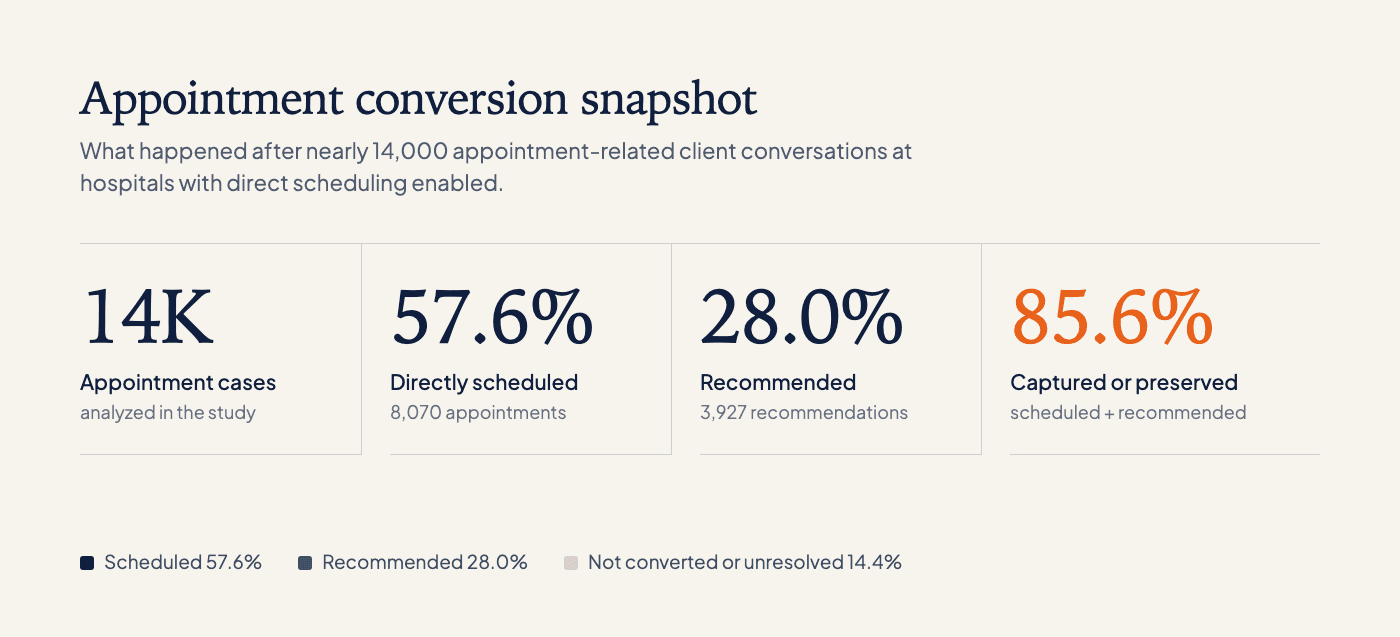
The overall conversion rate tells only part of the story. Separating scheduled appointments from recommended appointments provides a much clearer picture of front desk performance and client access.
Why This Matters
Practices often measure:
Number of incoming calls
Average call time
Speed to answer
Abandonment rate
These operational metrics are useful. But none of them answer the most important business question: what happened to the client’s intent? A client calling to schedule care has already moved beyond awareness. If that opportunity isn’t captured, or at least guided toward the next step, the practice risks losing much more than a single appointment. Potential downstream losses include:
Diagnostic testing
Treatment plans
Follow-up visits
Long-term preventive care
Future referrals
Lifetime client value
The phone conversation is simply the beginning of the client relationship.
Our Earlier Research Supports This
This finding aligns closely with another GuardianVets study. After surveying 9,948 pet owners, we asked what they would do if they couldn’t reach their veterinary practice after hours. Only 19.3% said they would simply try again later. The remaining 80.7% indicated they would take another action, including:
Contact another veterinary practice
Visit emergency or urgent care
Search online
Monitor the pet at home
Choose another course of action
That research reinforces a simple reality: client demand should never be assumed to wait.
If practices don’t provide a clear next step, clients will often create one themselves.
Appointment Capture Is Also a Revenue Metric
Appointment capture isn’t simply about operational efficiency. It’s about protecting revenue. Using an estimated appointment value of $350, with appointment recommendations weighted at a conservative 40% follow-through rate, GuardianVets estimated that the captured and preserved appointment opportunities represented approximately:
$3.37 million in estimated appointment opportunity during the study period
Approximately $595 per hospital per day
Nearly $17,800 per hospital per month
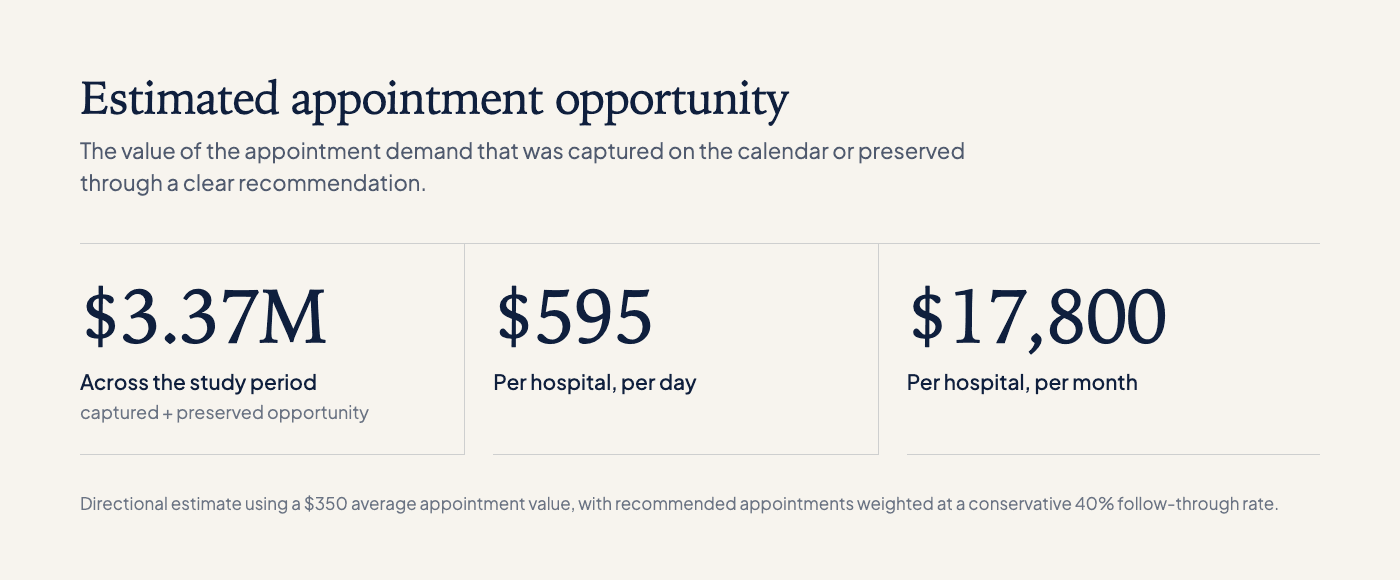
These figures are directional estimates rather than confirmed realized revenue, but they illustrate the financial importance of consistently capturing appointment demand.
Improving Appointment Capture
Improving appointment capture doesn’t mean forcing every client into an appointment. It means ensuring every appointment-related conversation ends with a clear path forward.
High-performing teams consistently:
Confirm appointment intent early.
Offer the earliest appropriate appointment.
Avoid asking clients to “call back tomorrow” without another option.
Follow consistent protocols for urgency and appointment type.
Provide alternatives when schedules are full, including waitlists, drop-off appointments, telemedicine, doctor review, or the next available opening.
Document appointment outcomes consistently.
Review conversion trends by appointment type, workflow, time of day, and team member.
Coach using real conversations instead of focusing only on call volume.
These behaviors improve both client experience and operational performance.
A Better KPI for Veterinary Leaders
Marketing creates demand. The front desk captures it. That’s why appointment capture deserves a place alongside production, average transaction value, and client retention as a core business KPI.
Practices shouldn’t simply ask: “Did we answer the phone?” They should ask: “Did we help this client take the next step?”
Because every appointment inquiry represents something valuable. Not just another phone call. A pet parent who has already chosen your practice.
Final Thoughts
Veterinary practices spend enormous effort building trust within their communities. When a client reaches out to schedule care, that trust has already produced an opportunity. The responsibility then shifts from marketing to operations.
Did the client receive a clear path to care?
GuardianVets’ analysis suggests that measuring Appointment Capture Rate provides a practical way to answer that question. Because ultimately, the goal isn’t simply answering more calls. It’s making sure every client who reaches out has the best possible opportunity to become the next appointment on the calendar.
Latest/Featured Blogs & News

Featured Blog
June 9, 2026
What Actually Happens on One After-Hours Call, Start to Finish
A client we will call Dana is on the couch with Baxter, a six-year-old Labrador who has vomited twice in the last hour and seems a little restless. Your clinic closed at six.
Featured Blog
September 16, 2026
Every Appointment Inquiry Is Revenue Waiting to Be Scheduled
Why Appointment Capture may be the most important KPI your veterinary practice isn’t measuring. We analyzed nearly 14,000 appointment-related client interactions to see what happens after the phone rings.

Featured Blog
June 9, 2026
How to Grow Your Veterinary Practice Without Adding Staff
Growth usually gets framed as a hiring problem. Demand climbs, the schedule tightens, and the reflex is to post another front desk role. But in a tight labor market, recruiting is slow, training takes months, and the person you hire might be gone by spring.