Featured Blog
On-Call – The Hidden Cost of Constant Availability

The blog argues that relying on veterinarians to personally handle every after-hours call is not a sustainable “system,” but a dependency that contributes to burnout, interruptions, and retention challenges. A stronger after-hours model uses trained veterinary professionals, triage workflows, escalation protocols, documentation, and PIMS integration so doctors are reserved for true emergencies while clients still receive timely support.
For many veterinary practices, after-hours coverage has always worked the same way. The phones ring. A client leaves a message. The veterinarian on call responds.
It’s a familiar model, and for years it has been viewed as simply part of the profession. But as practices grow, client expectations increase, and work-life balance becomes more important, it’s worth asking an uncomfortable question:
Is your after-hours system an actual system—or is it just a doctor carrying the burden?
Coverage and Sustainability Are Not the Same Thing
Many practices believe they have after-hours coverage because a veterinarian is available Technically, that’s true. But availability and sustainability are two very different things.
If every medication question, post-operative concern, vomiting episode, diarrhea case, behavioral issue, and “I’m not sure if this is an emergency” call can reach the doctor, then the doctor has effectively become the operating system. And that’s where problems begin.
A true operating system should function consistently regardless of who is working. It should create predictable workflows. It should filter, prioritize, document, and escalate appropriately. When every after-hours concern depends on a veterinarian answering the phone, the system depends on a single person.
That’s not scalability.
That’s dependency.
Not Every Call Needs a veterinarian
One of the biggest misconceptions in veterinary medicine is that every after-hours call requires direct veterinarian involvement. The reality is quite different. Many after-hours calls involve:
Medication questions
Post-operative concerns
Mild gastrointestinal issues
Follow-up care questions
General guidance requests
Appointment-related concerns
Questions about whether something can wait until morning
These are important calls. They deserve attention. But they do not always require a veterinarian to be the first point of contact. Without a triage layer, every concern has the potential to become a doctor interruption. That means veterinarians spend valuable time sorting through uncertainty rather than focusing on true emergencies.
The Hidden Cost of Constant Availability
Veterinarians are incredibly dedicated professionals. Most will answer calls because they care deeply about their patients and clients. But dedication should not be mistaken for efficiency. Every interrupted dinner. Every weekend phone call. Every late-night consultation. Every vacation disruption. These moments add up.
Over time, they contribute to:
Burnout
Compassion fatigue
Reduced work-life balance
Staffing challenges
Difficulty recruiting and retaining doctors
The practice may view the system as “working”. The veterinarian may have a different perspective.
Clients Need Guidance, Not Always a Doctor
Pet owners often call because they are uncertain. They don't know if the situation is urgent. They don't know if they should monitor symptoms, schedule an appointment, or seek emergency care. What they need first is guidance.
A structured triage process helps clients understand the next best step while ensuring true emergencies receive immediate attention. This creates a better experience for everyone involved. Clients receive support. Doctors receive fewer unnecessary interruptions. Practices maintain continuity of care.
What to Consider in an After-Hours Solution
Practices searching for a veterinary answering service should look beyond basic message taking. Today’s pet owners expect guidance, not just a voicemail or callback. The ideal solution combines live, trained Credentialed Veterinary Professionals with customizable workflows, escalation protocols, and seamless PIMS integration. This allows practices to provide expert after-hours support, access patient records, document directly within the medical record, schedule non-emergency appointments, and receive a nightly recap so the team starts each day fully informed.
What This Means for On Call Teams
The most effective after-hours systems do not remove veterinarians from the process. They reserve veterinarians for the situations where their expertise is truly needed. Instead of making the doctor the first stop for every concern, they create a clinical filtering process that:
Supports clients after hours
Identifies urgent situations
Escalates true emergencies
Documents interactions clearly
Reduces unnecessary interruptions
Protects continuity of care
The result is a more scalable and sustainable model.
The Real Question
Most veterinary practices are not trying to decide whether their doctors are willing to take after-hours calls. They already know the answer.
The real question is this:
Should your after-hours strategy depend on exhausting the same people your practice relies on most?
Clients need support after hours. Emergencies require escalation. Doctors play a critical role. But doctors should not be the operating system. They should be the experts the system is designed to protect. Because a sustainable practice isn’t built on constant interruption. It’s built on the right people handling the right situations at the right time.
Latest/Featured Blogs & News
Featured Blog
June 9, 2026
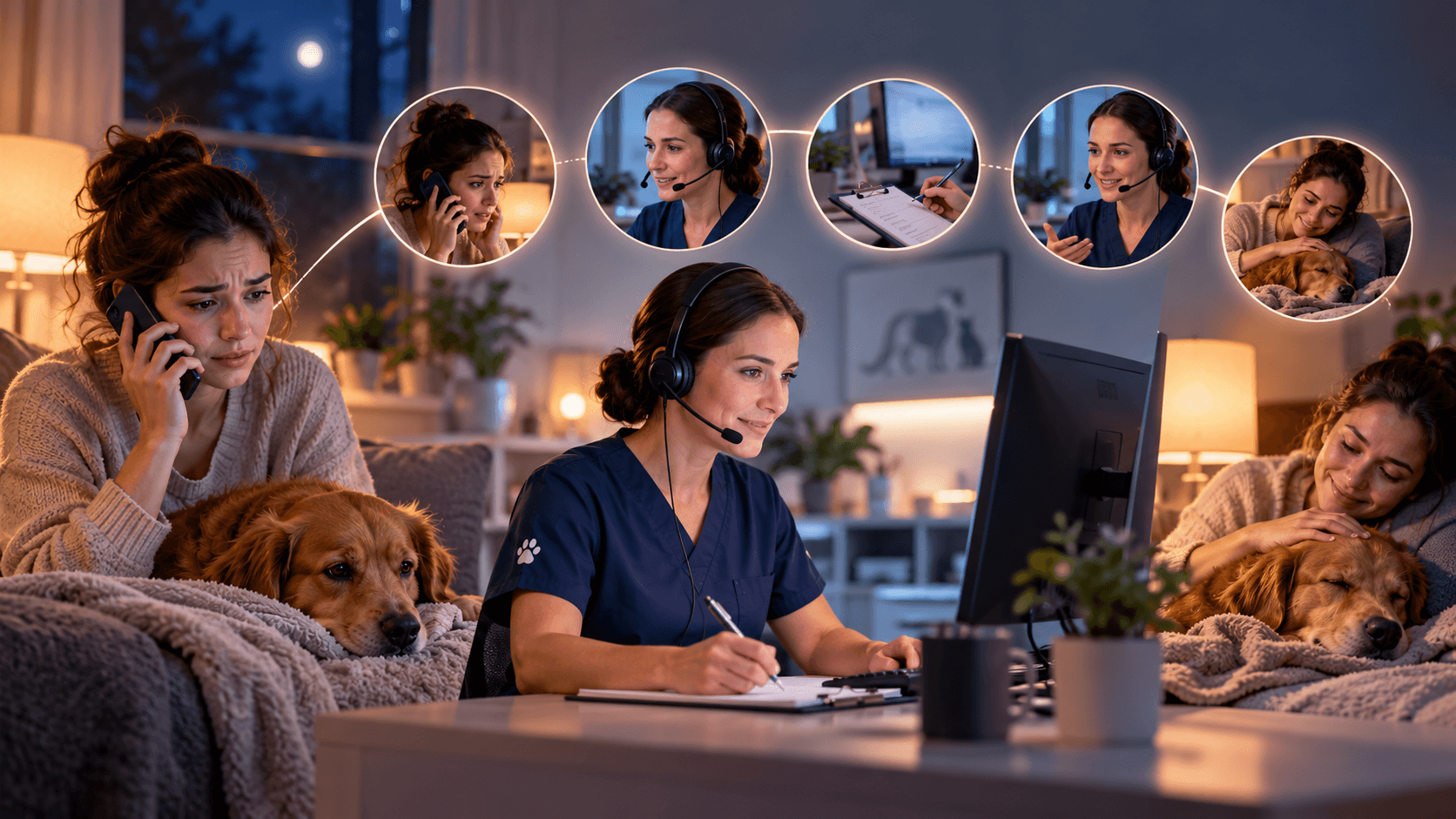
What Actually Happens on One After-Hours Call, Start to Finish
A client we will call Dana is on the couch with Baxter, a six-year-old Labrador who has vomited twice in the last hour and seems a little restless. Your clinic closed at six.

Featured Blog
September 16, 2026
Every Appointment Inquiry Is Revenue Waiting to Be Scheduled
Why Appointment Capture may be the most important KPI your veterinary practice isn’t measuring. We analyzed nearly 14,000 appointment-related client interactions to see what happens after the phone rings.

Featured Blog
June 9, 2026
How to Grow Your Veterinary Practice Without Adding Staff
Growth usually gets framed as a hiring problem. Demand climbs, the schedule tightens, and the reflex is to post another front desk role. But in a tight labor market, recruiting is slow, training takes months, and the person you hire might be gone by spring.