Featured Blog
Would They Really Call Back Later?

Would They Really Call Back Later?
New GuardianVets Survey Data Challenges One of Veterinary Medicine’s Biggest Assumptions
One of the most common assumptions in veterinary medicine sounds something like this:
“If a client can’t reach us after hours, they’ll simply call back tomorrow.”
It’s an understandable belief.
Your clients know you. They trust your team. They’ve entrusted you with the care of their pets, sometimes for years. Why wouldn’t they simply wait until the office opens?
The answer may surprise you.
GuardianVets analyzed nearly 10,000 after-hours pet parent survey responses to better understand what clients would have done if no one had answered their call. The results suggest that unanswered demand is often not delayed—it simply goes somewhere else.
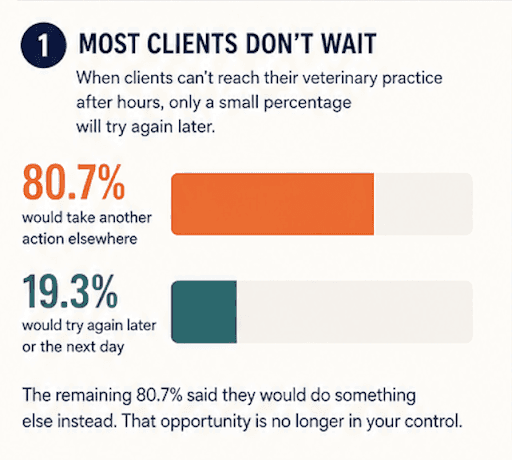
Most Pet Parents Don’t Wait
Where Do They Go Instead?
When after-hours support wasn’t available, pet parents reported they would:
32% call another veterinary practice or service
19% go directly to an emergency or urgent care hospital
19% try again later
13% monitor their pet at home
9% search online for answers
8% choose another option
For worried pet owners, urgency often outweighs loyalty. When they need guidance, they simply look for someone who can provide it.

Existing Clients Don’t Always Wait Either
Many practices assume this behavior applies mainly to prospective clients. The survey suggests otherwise.
Among current clients:
78.6% said they would take
another action.
Only 21.4% said they would
simply call back later.
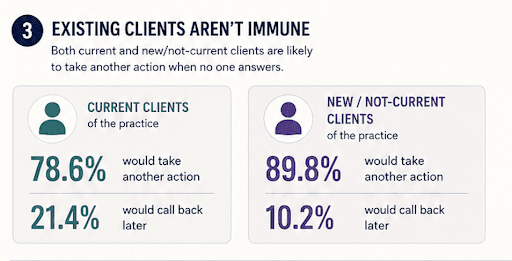
For clients who were not already established with the practice, the numbers were even more striking:
89.8% would take another action.
Only 10.2% would wait and try again later
This is important because it reframes after-hours accessibility as more than a convenience.
It’s both a client retention strategy and a new client acquisition opportunity
This Isn’t Just About Emergencies
Another common misconception is that after-hours calls are primarily emergency cases.
Our survey tells a different story.
The cases represented a broad mix of client needs:
47.5% Emergency or urgent care related
27.7% Appointment related
24.7% Administrative
Perhaps even more surprising, among appointment-related cases, only 24% of clients said they would simply try again later. The remaining 76% said they would take another action instead.
That challenges another long-held assumption, that appointment requests simply become tomorrow’s appointments.
Often, they don’t.
The Business Implication
For years, after-hours coverage has largely been viewed as an operational issue. Who’s carrying the phone?
Who’s on call? How do we cover nights and weekends?
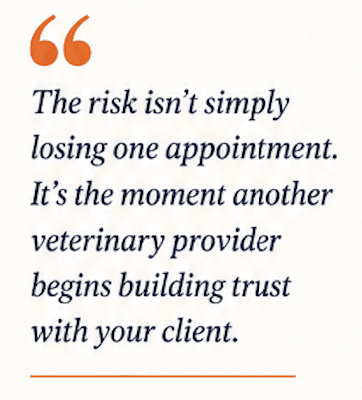
The survey suggests practices should also view it as a business strategy. Every unanswered interaction becomes an at-risk moment. Some clients will seek another veterinarian.
Some will choose urgent care. Some will build trust with another provider before your hospital ever has another opportunity to help. Accessibility is becoming a competitive advantage.
Final Thoughts
This research doesn’t suggest that every unanswered call becomes lost revenue, nor does it mean every client who chooses another action permanently leaves the practice.
But it does demonstrate something important. Client demand isn’t passive. When pet owners need help, they make decisions in real time. The practice that provides guidance often becomes the practice they remember.
After-hours support isn’t simply about answering phones. It’s about protecting the relationships you’ve spent years building and creating new ones that might never have existed otherwise.
Latest/Featured Blogs & News

Featured Blog
September 16, 2026
Every Appointment Inquiry Is Revenue Waiting to Be Scheduled
Why Appointment Capture may be the most important KPI your veterinary practice isn’t measuring. We analyzed nearly 14,000 appointment-related client interactions to see what happens after the phone rings.

Featured Blog
June 9, 2026
How to Grow Your Veterinary Practice Without Adding Staff
Growth usually gets framed as a hiring problem. Demand climbs, the schedule tightens, and the reflex is to post another front desk role. But in a tight labor market, recruiting is slow, training takes months, and the person you hire might be gone by spring.

Featured Blog
August 12, 2026
When Common Doesn’t Mean Highest Risk: